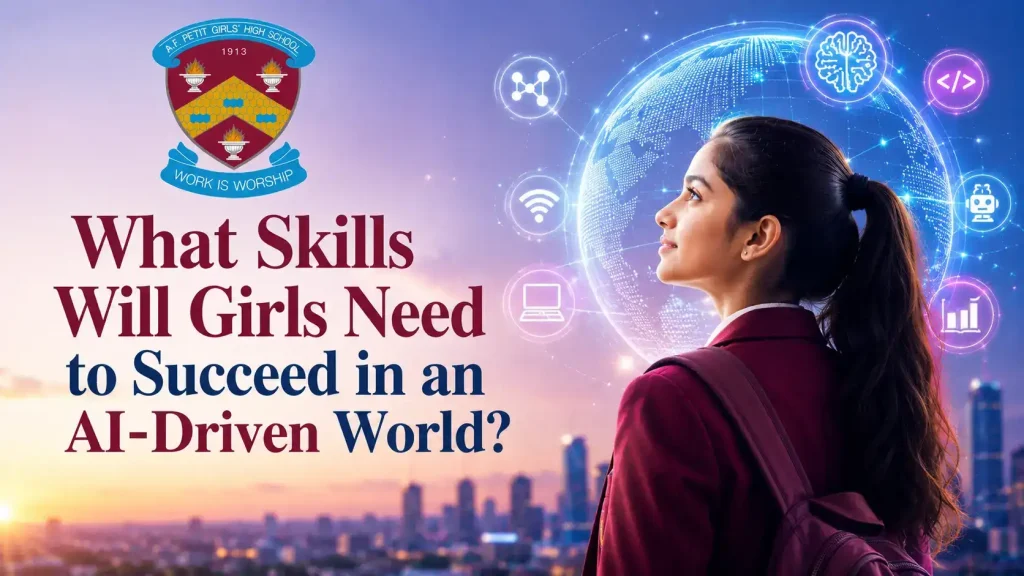
AI is changing how we learn, work, create and solve problems. For today’s girls, preparing for this future is not simply about learning to code or becoming an AI engineer. It is about developing the ability to understand technology, question it, use it creatively, make ethical decisions and remain confidently in control of their own thinking.
TL;DR
The most valuable skills girls will need in an AI-driven world include AI literacy, critical thinking, adaptability, problem-solving, digital and data literacy, creativity, collaboration, communication, leadership, entrepreneurship, ethical reasoning, resilience and independent decision-making.
The goal should not be to prepare every girl for a career in artificial intelligence. It should be to prepare every girl to work effectively with AI, understand its limitations, challenge its outputs and use technology to solve meaningful problems.
For parents and schools, this means moving beyond traditional academic achievement and creating opportunities for girls to ask questions, experiment, collaborate, lead projects, solve real-world problems and use technology responsibly.
At Bai Avabai Petit Girls’ High School, this philosophy aligns naturally with an approach that combines academics, technology-enabled learning, life skills, social-emotional learning and opportunities for students to develop independence.
Introduction: The Future Will Not Be Human vs. AI
Imagine a student beginning her career ten or fifteen years from now.
She may work with an AI assistant that analyses research, help develop medicines using machine learning, run a business supported by automated systems, design products with generative tools, or work in a profession that does not yet exist.
The important question is therefore not:
“Will AI take away her future job?”
A better question is:
“Will she have the skills to use AI intelligently while contributing the human abilities that technology cannot simply replace?”
Artificial intelligence is already changing education and the workplace. The World Economic Forum’s Future of Jobs Report 2025, based on the perspectives of more than 1,000 employers representing more than 14 million workers, identifies analytical thinking as a key core skill while AI and big data, technological literacy, creative thinking, resilience and leadership are among the important capabilities shaping the future of work.
For girls, there is another reason this conversation matters.
The AI revolution is also a gender opportunity.
The World Economic Forum reports that women represented 29.4% of people listing AI engineering skills on LinkedIn in 2025, up from 23.5% in 2018. Yet women remain underrepresented in AI and technology-related skills and careers.
Education can help change that trajectory.
The objective should not simply be to teach girls how to use AI.
It should be to help them become the people who question it, design with it, improve it, lead teams around it and decide how it should be used.
What Skills Will Girls Need in an AI-Driven World?
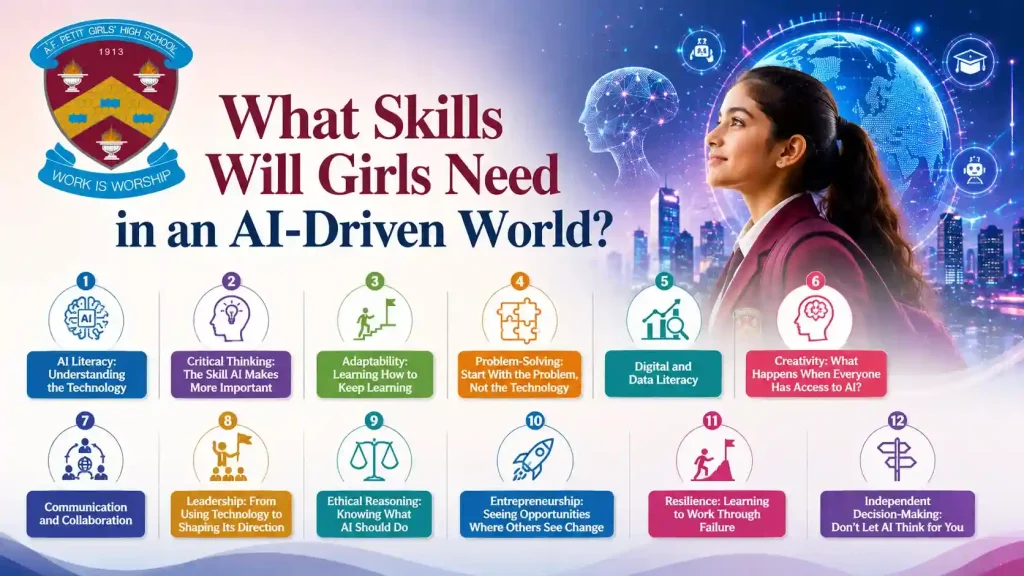
1. AI Literacy: Understanding the Technology
The first step is understanding what AI actually is.
AI literacy does not mean every student needs advanced programming knowledge. Instead, girls should gradually understand concepts such as:
- How AI systems learn from data
- What generative AI can and cannot do
- Why AI sometimes produces incorrect information
- How algorithms influence what people see online
- Why data quality matters
- What prompts and instructions do
- How AI can be used in different professions
- When human judgement is necessary
UNESCO’s AI Competency Framework for Students identifies 12 competencies across four dimensions: human-centred mindset, ethics of AI, AI techniques and applications, and AI system design. It also describes progression from understanding to applying to creating.
This is an important distinction.
A future-ready student should not simply know how to ask ChatGPT a question.
She should know when to use AI, how to evaluate the answer and when not to trust it.
What parents can do
Instead of treating AI as either completely good or completely bad, parents can discuss it with their daughters.
Ask:
“How do you think this AI produced that answer?”
“How could we check whether this information is correct?”
“What information should we never share with an AI tool?”
These simple conversations develop AI awareness without turning technology into another examination subject.
2. Critical Thinking: The Skill AI Makes More Important
If AI can produce an answer in seconds, memorising information becomes less valuable on its own.
Knowing how to evaluate information becomes more important.
Girls need to learn to ask:
- Is this information accurate?
- What evidence supports it?
- Is there another perspective?
- Could the AI be biased?
- What information might be missing?
- Does this solution actually solve the problem?
This is particularly important because AI systems can generate convincing but inaccurate information.
Schools therefore need to preserve activities that require students to think independently: debates, discussions, research projects, experiments, presentations and problem-solving exercises.
A student who can challenge an AI-generated answer is more future-ready than one who can simply generate one.
3. Adaptability: Learning How to Keep Learning
The technology students learn today will change.
Some tools that are popular now may disappear. New AI systems will emerge. Entire industries will adopt new workflows.
That makes adaptability one of the most valuable long-term skills.
Girls should develop the confidence to say:
“I don’t know this yet, but I can learn it.”
That mindset is more powerful than trying to predict exactly which technology will dominate ten years from now.
At Bai Avabai Petit, students in the secondary section are encouraged to develop independence and take greater responsibility for their learning, including using library and internet resources for reference work and projects.
That kind of independent learning is increasingly relevant in an AI-driven world.
4. Problem-Solving: Start With the Problem, Not the Technology
One of the biggest mistakes in technology education is teaching students to use tools without teaching them how to identify meaningful problems.
Future-ready girls should learn to ask:
“What problem are we actually trying to solve?”
For example, instead of simply asking students to build an AI project, a school could ask:
- How could technology reduce food waste?
- How could students make public spaces safer?
- How could we improve access to educational resources?
- How could data help us understand environmental problems?
- How could technology help people with disabilities?
Once the problem is clear, technology becomes a means rather than the objective.
This approach also encourages girls to see themselves as problem-solvers and innovators, not just technology users.
5. Digital and Data Literacy
AI runs on data.
That means understanding data will become increasingly important even for people who never become data scientists.
Girls should learn how to:
- Read charts and graphs
- Identify patterns
- Understand basic statistics
- Distinguish correlation from causation
- Question the source of data
- Protect personal information
- Recognise misleading visualisations
- Understand how biased data can produce biased outcomes
This matters in everyday life as much as in professional careers.
A future doctor may use AI to analyse medical information.
A journalist may use data to investigate a story.
An entrepreneur may use customer data to make business decisions.
A lawyer may work with AI-assisted research.
A designer may analyse user behaviour.
Data literacy therefore belongs to every student’s education, not only the STEM classroom.
6. Creativity: What Happens When Everyone Has Access to AI?
Generative AI can create text, images, presentations, music, software and ideas.
So what happens to creativity?
It becomes even more important.
When everyone can generate content, the differentiator becomes the ability to:
- Develop original ideas
- Make connections between different subjects
- Ask unusual questions
- Understand people
- Develop a unique perspective
- Improve an existing idea
- Turn imagination into something useful
Girls should therefore have opportunities to participate in art, writing, design, music, drama, debate, science projects and experimentation.
Bai Avabai Petit already offers a broad range of co-curricular opportunities, including elocution, debates, JAM, drama, music, sports, chess and other activities.
These activities are not distractions from future-ready education.
They are part of it.
7. Communication and Collaboration
AI may automate individual tasks, but meaningful work will still require people to communicate and collaborate.
Girls need to be able to:
- Explain complex ideas simply
- Listen to different viewpoints
- Give and receive feedback
- Present their work
- Work in teams
- Resolve disagreements
- Communicate with confidence
This is one area where girls already demonstrate considerable potential.
The World Economic Forum’s gender research notes relatively strong female participation in areas such as collaboration, leadership and social influence compared with some technology-related skill categories.
The opportunity is to combine these human strengths with technological capabilities.
The future needs girls who can understand technology and communicate its impact, not one or the other.
8. Leadership: From Using Technology to Shaping Its Direction
Leadership in an AI-driven world will not simply mean managing people.
It will mean making decisions when technology creates new possibilities and new risks.
A future leader may need to decide:
- Should an organisation use an AI system?
- What data should it collect?
- How should customer information be protected?
- How should AI-generated decisions be reviewed?
- Who is responsible when an automated system makes a mistake?
These questions require judgement.
Girls should therefore have opportunities to lead teams, organise activities, manage projects, speak publicly and make decisions.
Leadership becomes stronger when students are trusted with genuine responsibility.
9. Ethical Reasoning: Knowing What AI Should Do
Just because technology can do something does not mean it should do it.
This may be one of the most important lessons schools can teach.
Girls should understand concepts such as:
- Privacy
- Consent
- Algorithmic bias
- Digital footprints
- Misinformation
- Intellectual property
- Deepfakes
- Responsible use of personal data
- Fairness and inclusion
UNESCO places ethics at the centre of its student AI competency framework, alongside human-centred thinking, AI techniques and AI system design.
This means ethical AI education should not be treated as an advanced topic reserved for university students.
Age-appropriate conversations can begin much earlier.
10. Entrepreneurship: Seeing Opportunities Where Others See Change
AI will not only change existing jobs.
It will create new products, services and business models.
Girls should therefore learn entrepreneurial thinking:
Identify a problem → understand the people affected → develop an idea → test it → improve it → communicate its value.
They do not need to launch a company at school.
They can practise entrepreneurship through:
- School projects
- Innovation challenges
- Community initiatives
- Product design
- Fundraising activities
- Student-led clubs
- Research projects
- Problem-solving competitions
The purpose is to develop initiative.
A future entrepreneur may use AI to build a business, but the original opportunity still begins with human observation and understanding.
11. Resilience: Learning to Work Through Failure
AI can make experimentation faster.
But faster experimentation also means students may encounter more failures.
A program doesn’t work.
An idea doesn’t solve the problem.
A presentation doesn’t communicate the concept.
An AI-generated answer turns out to be wrong.
Future-ready students need to understand that failure is information.
Bai Avabai Petit’s life-skills and social-emotional learning programmes already address areas including self-motivation, peer relationships, conflict resolution, study skills, time management, stress management and self-image.
These capabilities matter because technological change will create uncertainty.
Resilience gives girls the ability to adapt without losing confidence.
12. Independent Decision-Making: Don’t Let AI Think for You
Perhaps the most important skill of all is knowing when to put the technology aside.
If a student uses AI to brainstorm an essay, she should still develop the argument herself.
If AI explains a mathematics problem, she should still understand how to solve it.
If AI recommends a career, she should consider her own interests, strengths and values.
If AI provides information, she should verify it.
The objective is not AI dependence.
It is AI augmentation.
The girl remains the thinker.
AI remains the tool.
This distinction will become increasingly important as AI becomes more capable.
What Do These Skills Look Like at Different Ages?
Future-ready education does not need to begin with advanced AI courses.
The skills can develop gradually.
Primary School: Build Curiosity
For younger girls, focus on:
- Asking questions
- Exploring technology
- Building and creating
- Storytelling
- Teamwork
- Basic digital safety
- Observation
- Experimentation
- Creative problem-solving
At this stage, the goal is not technical mastery.
It is curiosity and confidence.
Bai Avabai Petit’s pre-primary approach already uses play, hands-on activities, observation, teamwork and creativity as important parts of early learning.
Middle School: Build Capability
As girls grow older, schools can introduce:
- Basic coding
- Data interpretation
- AI concepts
- Digital research
- Media literacy
- Collaborative projects
- Design challenges
- Debate and presentation
- Ethical discussions about technology
The focus should shift from “What is this technology?” to “What can I create or solve with it?”
Secondary School: Build Agency
Older students can take on more sophisticated challenges:
- AI-assisted research
- Data projects
- Coding and computational thinking
- Entrepreneurship
- Robotics
- Research projects
- AI ethics
- Innovation challenges
- Community problem-solving
- Career exploration
At this stage, students should increasingly move toward UNESCO’s progression of understanding, applying and creating.
What Can Parents Do to Prepare Their Daughters?
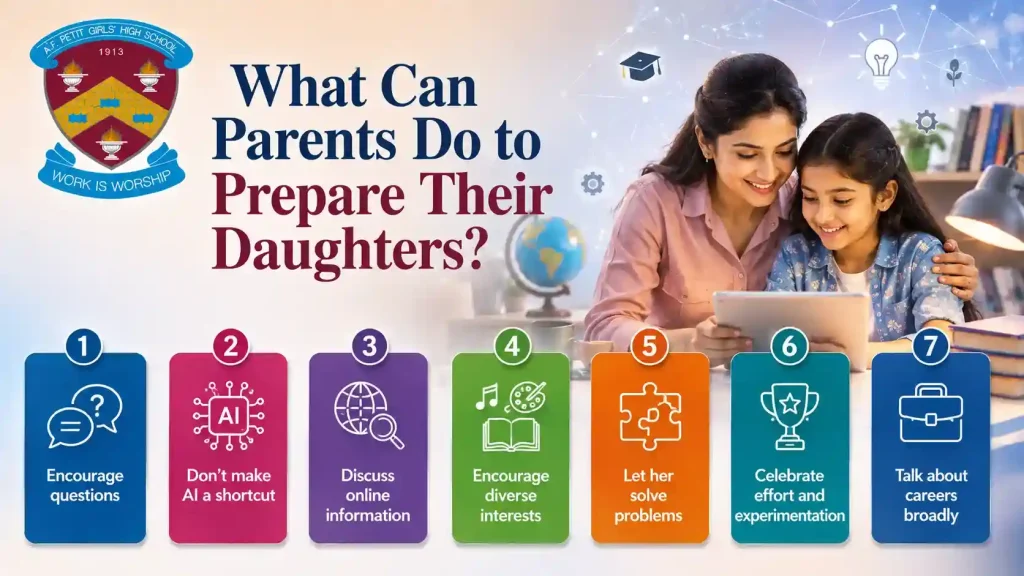
Parents do not need to become AI experts.
Their role is to create the right environment.
1. Encourage questions
When your daughter asks “Why?”, don’t always provide the answer immediately.
Ask her what she thinks first.
2. Don’t make AI a shortcut
If she uses AI for homework, encourage her to explain the answer in her own words.
3. Discuss online information
Teach her to question sources, images, videos and recommendations.
4. Encourage diverse interests
Technology is important, but so are reading, sports, music, art, communication and social interaction.
5. Let her solve problems
Resist the temptation to solve every challenge for her.
Independence grows through practice.
6. Celebrate effort and experimentation
A failed experiment can teach more than a perfect answer copied from an AI system.
7. Talk about careers broadly
Don’t tell girls that AI means they must become programmers.
Show them how AI connects with medicine, law, design, science, business, education, journalism, finance, environmental work and entrepreneurship.
What Can Schools Do?
The strongest AI education will not come from adding one isolated “AI period” to the timetable.
It can be integrated across subjects.
In Science
Students can use data to investigate environmental or scientific questions.
In Mathematics
Students can analyse datasets, identify patterns and question AI-generated solutions.
In English
Students can compare human-written and AI-generated arguments and evaluate their quality.
In Social Studies
Students can discuss algorithmic bias, misinformation, privacy and the social impact of automation.
In Art
Students can explore the relationship between human creativity and generative tools.
In Entrepreneurship
Students can identify community problems and design technology-supported solutions.
This interdisciplinary approach reflects the reality of the workplace.
AI will not belong to one department.
It will influence almost every field.
What Real-World Examples Can Teach Us
The strongest evidence for girls’ AI education comes from programmes where students are not simply taught about technology but asked to use it to solve real problems.
UNESCO and Technovation previously ran an AI programme for girls aged 10–18 across multiple countries, including India. More than 3,000 girls participated and more than 250 submitted final projects. Indian participants developed ideas including AI-assisted water-quality monitoring, judicial applications and mental-health support concepts.
Another UNESCO-supported girls’ AI programme in Pakistan involved 466 girls working on AI models addressing issues such as education, healthcare, environmental pollution, cyberbullying and water scarcity.
These examples demonstrate something important:
Girls don’t need to wait until adulthood to become technology problem-solvers.
They can start identifying meaningful problems and imagining technological solutions while they are still at school.
A separate UNESCO and Microsoft AI hackathon brought together 80 secondary-school girls from 11 countries. Students explored AI, data collection, image classification and predictive modelling before designing solutions connected to sustainability and biodiversity.
The lesson for schools is clear: hands-on experiences can turn abstract technology into agency.
India Has an Important Opportunity
India’s rapidly expanding digital economy makes these skills particularly relevant.
But access and participation still matter.
UNESCO’s State of the Education Report for India 2022, which focused on AI in education, highlighted persistent digital-access challenges affecting adolescent girls. The report noted that 85% of surveyed adolescent girls did not have a laptop or computer at home, while 83% had access to a computer lab for less than an hour a week in the cited survey context.
This highlights an important principle:
AI education cannot simply be about giving students access to AI tools.
Students also need meaningful opportunities to use technology, understand it, question it and create with it.
India’s National Education Policy ecosystem has also included initiatives related to digital education, AI for public awareness and the National Digital Education Architecture.
The direction is increasingly clear: technology is becoming part of education, but technology must be accompanied by strong foundational and human capabilities.
The Bigger Opportunity for Girls
There is a tendency to discuss AI education in terms of future employment.
But the opportunity is much larger.
Imagine a girl who learns to:
Question information → analyse data → identify a problem → collaborate with others → use AI to explore solutions → evaluate the results → communicate her idea → make an ethical decision → lead implementation.
That student is not merely prepared for an AI-related job.
She is prepared for almost any future.
This is particularly important for girls because the future of AI should not be designed without them.
If women remain underrepresented in the development and leadership of AI systems, technology risks reproducing existing gaps.
The World Economic Forum has highlighted continuing gender gaps in AI-related skills and STEM careers, even while women’s participation in AI engineering skills has improved.
The answer begins much earlier than the workplace.
It begins in the classroom.
How Avabai Petit School Can Help Prepare Girls for the AI Era
A future-ready girls’ school does not need to choose between technology and holistic education.
It needs to bring them together.
At Bai Avabai Petit Girls’ High School, the existing emphasis on technology-enabled learning, computer and science facilities, life skills, social-emotional learning, cyber wellness, co-curricular activities and independent learning provides a strong foundation for this approach.
The next step is to ensure that girls see themselves not only as users of technology but as creators, researchers, entrepreneurs, leaders and responsible decision-makers.
That could mean giving students opportunities to:
- Investigate real-world problems
- Work on interdisciplinary projects
- Explore age-appropriate AI tools
- Learn how to verify AI-generated information
- Participate in coding and technology challenges
- Present technology-based solutions
- Discuss AI ethics
- Analyse data
- Work in teams
- Lead innovation projects
- Connect technology with community needs
The aim isn’t to predict exactly what careers today’s students will have.
It is to give them the confidence and capability to navigate whatever comes next.
The Most Important Skill May Be Knowing Who You Are
There is one final skill that deserves more attention: self-awareness.
AI can recommend.
AI can predict.
AI can generate.
AI can optimise.
But it cannot decide what kind of person a student wants to become.
A successful future will require girls who understand their strengths, values, interests and responsibilities.
Technology can help them go further.
It should never determine their direction for them.
The future-ready girl is therefore not the one who knows every AI tool.
She is the one who can say:
“I can learn new technology.”
“I can question what it tells me.”
“I can solve problems creatively.”
“I can make responsible decisions.”
“I can work with people.”
“And I can use technology to create something meaningful.”
Conclusion: Prepare Girls to Shape the Future, Not Just Survive It
The AI-driven world will reward more than technical knowledge.
It will need people who can think critically, adapt quickly, communicate clearly, solve complex problems, lead responsibly and continue learning.
For girls, this is an opportunity to move from being passive consumers of technology to becoming active participants in shaping it.
Schools and parents have an important role to play.
Give girls technology, but also give them questions.
Give them AI, but also teach them judgement.
Give them opportunities to experiment, but let them experience failure.
Teach them technical skills, but nurture creativity, empathy and leadership.
Most importantly, give them the confidence to believe that the future of technology is not something being created for them.
It is something they can help create.
For a girls’ school such as Bai Avabai Petit, that is ultimately what future-ready education should mean: not preparing girls for one particular career, but developing capable, curious and confident young women who can enter an uncertain future and help shape it.
Key Takeaways
- AI literacy will help girls understand and use emerging technologies responsibly.
- Critical thinking will help them identify inaccurate, biased or misleading AI outputs.
- Adaptability will prepare them for continuous technological change.
- Problem-solving will help them use technology to address meaningful challenges.
- Data and digital literacy will become valuable across almost every profession.
- Creativity will remain a uniquely important human capability in an age of generative AI.
- Communication and collaboration will help girls work effectively with people and technology.
- Leadership will prepare them to influence how AI is developed and implemented.
- Ethical reasoning will help them consider the consequences of technological decisions.
- Entrepreneurship will help girls identify opportunities created by technological change.
- Resilience will help them navigate uncertainty and failure.
- Independent decision-making will ensure that AI remains a tool rather than a substitute for human judgement.
Frequently Asked Questions
Girls will need a combination of AI and human skills, including AI literacy, critical thinking, creativity, adaptability, problem-solving, data literacy, communication, collaboration, leadership, ethical reasoning, resilience and independent decision-making.
No. Coding can be valuable, but AI will influence careers far beyond technology. Doctors, lawyers, designers, teachers, entrepreneurs, researchers, journalists and business leaders will increasingly work with AI. The broader goal is AI literacy and the ability to use technology intelligently.
Parents can encourage curiosity, independent problem-solving, responsible technology use, reading, creativity, communication and experimentation. They should also teach girls to question and verify information generated by AI rather than accepting it automatically.
Age-appropriate, supervised use can help students learn about AI, but it should not replace independent thinking. Students should understand how to verify information, protect personal data, acknowledge AI assistance where appropriate and develop their own reasoning.
Because an AI-generated answer is not automatically correct. Students need critical thinking to evaluate accuracy, evidence, bias, context and relevance. The ability to judge an answer can be more valuable than the ability to generate one.
Schools can combine AI activities with discussions, experiments, handwritten or independent work, debates, research, creative projects and real-world problem-solving. AI should extend learning rather than replace the thinking process.
Women remain underrepresented in AI and several STEM fields. Giving girls early exposure to technology, problem-solving and AI can help them participate not only as users but also as researchers, creators, entrepreneurs and leaders in the future technology ecosystem.
There is no single skill. However, the ability to learn, question, adapt and make independent decisions may be one of the strongest foundations because technologies and job requirements will continue to change.