Ask any child in Mumbai what the monsoon means to her, and you will hear about paper boats, puddle jumps and the joy of a surprise holiday. Ask one more question, like why the water on her street does not drain away, and the conversation suddenly gets interesting. That spark of curiosity is where environmental education truly begins, and the classroom is the best place to nurture it.
Children today hear words like climate change, plastic pollution and heatwaves almost daily. What they often lack is a calm, guided space to understand these ideas, ask questions and figure out what they can actually do about them. Schools can offer exactly that. At Bai Avabai Framji Petit Girls’ High School, we see caring for the environment not as a one-day activity around World Environment Day, but as a way of thinking that grows with every lesson.
In this blog, we look at what environmental education really means, why the classroom is the right starting point, and how teachers and parents can work together to raise children who care for the world around them.
What Is Environmental Education?
Environmental education is learning that helps children understand how nature works, how human choices affect it, and how they can make responsible decisions in daily life. It is not limited to one textbook chapter on pollution. It blends science, geography, social studies, language and even art.
Put simply, it helps a child answer three questions: How does the world around me work? How do my actions affect it? And what can I do to help?
Environmental Education vs Environmental Awareness
Awareness is knowing that plastic harms the ocean. Education goes a step further. It teaches a child why plastic does not break down, where her waste goes after it leaves home, and which small habits make a real difference. Awareness informs; education changes behaviour.
Why the Classroom Is the Right Place to Start?
Children spend a large part of their day at school. The habits they practise there, from switching off fans to carrying a refillable water bottle, slowly become part of who they are. Here is why the classroom matters so much.
1. Habits Formed Early Tend to Last
Values picked up in childhood are the hardest to shake. A girl who learns to separate wet and dry waste at eight is far more likely to do it without thinking at eighteen. When parents look for the right Girls Primary School Mumbai has to offer, it is worth asking how the school builds everyday habits like these, not just how it prepares children for tests.
2. Teachers Make Big Topics Less Frightening
News about melting glaciers or record heat can leave young children anxious. A good teacher breaks these topics into age-appropriate pieces, explains the science gently and always ends on a hopeful note: what people around the world are doing, and what children can do too. This balance helps students feel capable rather than helpless.
3. It Connects Every Subject
Environmental learning fits naturally into almost every period of the day. A maths lesson can measure how much water a leaking tap wastes in a week. A geography class can explore why Mumbai’s mangroves protect the coastline. An English period can become a persuasive letter about a littered street. When children see the same idea from different angles, it stays with them.
4. Schools Can Lead by Example
A school that saves electricity, reduces paper use and cares for its green spaces is teaching even when no lesson is going on. Students learn as much from what they see around them as from what they read.
How Environmental Education Supports a Child’s Overall Growth?
The benefits go well beyond knowing facts about nature. Environmental education builds skills that help children in every part of life.
Critical Thinking and Problem-Solving
When students investigate why a nearby lake looks polluted or why the school garden keeps drying out, they learn to ask questions, gather facts and suggest solutions. This kind of hands-on inquiry is closely linked to project-based learning, where students turn classroom knowledge into real-world solutions.
Responsibility and Empathy
Looking after a plant, feeding birds or keeping a shared space clean teaches children that their actions affect others. That sense of responsibility carries over into how they treat classmates, family and their wider community.
Leadership and Confidence in Girls
Environmental projects give girls a natural reason to speak up, lead small teams and present ideas in front of others. Planning a recycling drive or sharing a water-saving idea at assembly builds confidence that lasts. These are among the life skills schools should teach alongside academics, and they matter long after school ends.
Better Wellbeing
Time spent outdoors, gardening or simply observing nature is often linked with calmer minds and better focus in children. Learning about the environment naturally encourages more of these moments beyond the four walls of a classroom.
Why It Matters Even More for Children in Mumbai
City children live with environmental challenges every day. Monsoon flooding, hotter summers, hazy winter air and shrinking open spaces are all part of growing up in Mumbai. Maharashtra banned many single-use plastic items back in 2018, yet plastic waste is still easy to spot on our beaches and streets.
For a Mumbai child, environmental education is not about faraway rainforests. It is about understanding her own neighbourhood, from the trees on her road to the drains outside her school, and realising that small local actions really do add up.
Learning From Local Examples
The city itself is a wonderful outdoor classroom. The mangroves along our coastline, the green stretches of Sanjay Gandhi National Park and the community beach clean-ups at places like Versova give teachers real, relatable examples. Lessons feel alive when children can picture the place being discussed.
Practical Ways to Bring Environmental Education Into the Classroom
Meaningful environmental learning does not need expensive equipment. The most effective ideas are simple, regular and fun.
Simple Activities for Primary Classes
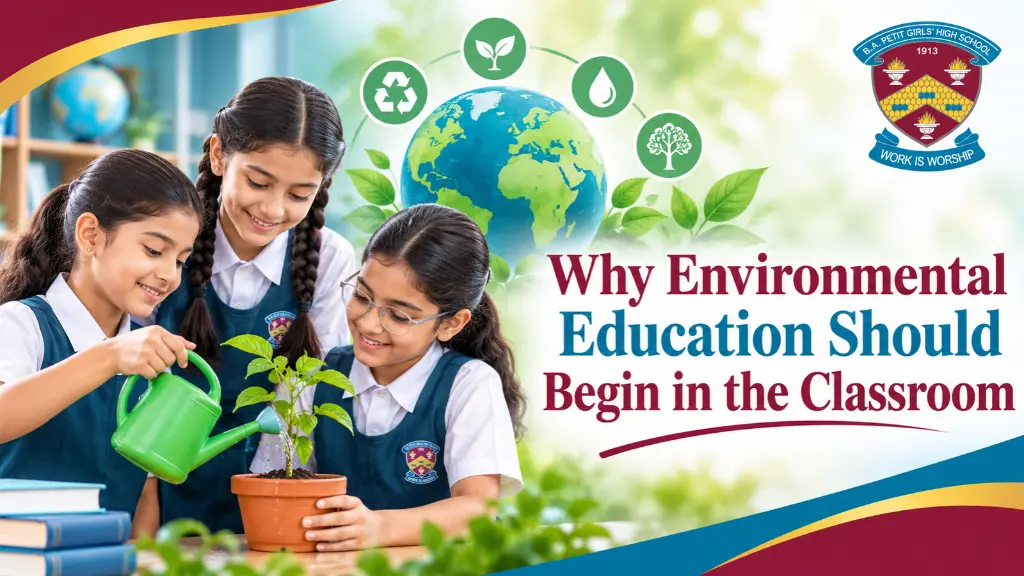
1. Seed and Plant Projects: Growing a bean plant in a recycled cup teaches patience, observation and basic science, all at once.
2. Waste Segregation Corners: Colour-coded bins in every classroom turn sorting waste into a daily routine instead of a rule to remember.
3. Nature Journals: Children draw or write about a tree, bird or cloud they noticed that week. It sharpens attention and builds vocabulary.
4. Water and Energy Checks: Young “monitors” can make sure taps are closed and lights are off before recess, which gives them a small sense of ownership.
Activities for Older Students
1. Research on Local Issues: Students can study a real problem, such as noise or air quality near the school, and present their findings and ideas.
2. Eco Clubs and Student Committees: Student-led clubs plan awareness drives, upcycling workshops and green campaigns, giving girls real leadership experience.
3. Debates and Awareness Campaigns: Debating topics like “Should plastic packaging be taxed?” helps students see different sides of an issue and express their views clearly.
The Role of Parents in Continuing the Lesson at Home
What a child learns at school grows stronger when it is practised at home. Parents do not need to become experts. Letting your daughter manage the family’s recycling, carrying cloth bags to the market together, walking short distances instead of driving, and talking about environmental news over dinner all send a simple message: this matters in our home too.
When school and home speak the same language, children stop seeing green habits as homework and start seeing them as normal life.
Environmental Learning at Bai Avabai Framji Petit Girls’ High School
As a Parsi school in Mumbai with a long tradition of educating girls, Bai Avabai Framji Petit Girls’ High School believes that good education prepares students for life, not only for exams. Respect for the natural elements, such as water, earth and fire, has long been part of Parsi heritage, and that spirit of care fits naturally into how we guide our students.
Through classroom discussions, activities and school events, our girls are encouraged to observe, ask questions and take thoughtful action. The goal is simple: to help every student see herself as a caretaker of her surroundings and a confident voice for positive change.
Conclusion: Small Lessons, Lifelong Impact
Environmental education is not one more subject squeezed into a busy timetable. It is a way of seeing how everything is connected, from the water we use to the air we breathe. When this learning begins early in the classroom, it shapes thoughtful, responsible and confident young people who carry these values into their homes, careers and communities.
The children sitting in our classrooms today will be the ones making decisions about our cities tomorrow. Giving them the knowledge and confidence to care for the planet may be one of the most valuable lessons any school can teach.
Looking for a school that prepares your daughter for exams and for life? Explore admissions at Bai Avabai Framji Petit Girls’ High School or send us an enquiry to plan a visit and meet our teachers.
FAQs
1. What is environmental education in schools?
Environmental education in schools teaches children how nature works, how human actions affect it, and how they can make responsible choices. It blends science, geography and life skills through lessons, activities and real-world projects.
2. Why should environmental education start at a young age?
Habits and values formed in early childhood tend to last. When children learn to save water, reduce waste and respect nature in primary school, these actions become natural behaviour they carry into adulthood.
3. How can teachers include environmental education in the classroom?
Teachers can link it to everyday subjects, such as measuring water wastage in maths or writing about pollution in English. Classroom gardens, waste segregation, nature journals and local projects also make learning practical.
4. Is environmental education part of the Indian school curriculum?
Yes. Following a Supreme Court directive, environmental education is a compulsory part of school learning in India. The National Education Policy 2020 also encourages awareness of climate change and sustainability across subjects.
5. How can parents support environmental education at home?
Parents can involve children in recycling, carry cloth bags, save water and electricity together, and talk about environmental news at home. When families practise what schools teach, children see green habits as normal.
6. What are some easy environmental activities for primary school students?
Simple activities include growing plants in recycled cups, sorting classroom waste into coloured bins, keeping a nature journal, switching off unused lights, and joining supervised clean-up drives with classmates and teachers.