Ask any child about her favourite story and watch her face light up. Long before textbooks and exams, stories are a child’s first window into lives beyond her own. For parents searching for a Girls Primary School Mumbai families can trust, it helps to know how much quiet learning happens the moment a teacher opens a book and begins, “Once upon a time…”
At Bai Avabai Framji Petit Girls’ High School, we see this every day. A well-told tale does far more than entertain. It teaches young girls to pause, wonder how someone else feels, and respect experiences that differ from their own.
In this blog, we explore how storytelling shapes empathy, understanding, and confidence in children, and how parents can keep that learning alive at home.
Why Stories Matter So Much in the Early Years?
Children are natural storytellers. Even before they can read, they make sense of their day by narrating it: who shared a tiffin, who cried during recess, what happened on the bus ride home. Stories give shape to experiences that might otherwise feel confusing.
Between the ages of five and eleven, a child’s world expands rapidly. She begins to notice that a classmate celebrates different festivals, speaks another language at home, or lives with her grandparents. Stories help her place these differences in context, with curiosity rather than judgment.
Psychologist Keith Oatley, who has studied fiction for decades, describes reading as a kind of “flight simulator” for social life. When a young reader follows a character through a problem, she practises reading emotions, predicting reactions, and weighing choices, all within a safe, imaginative space.
How Storytelling Helps Children See Through Other Eyes?
1. Seeing the World Through a Character’s Eyes
When a child listens to a story, she quietly becomes part of it. For a few minutes, she might be a girl selling flowers at a busy railway station, a nervous student on her first day, or a little sparrow rebuilding its nest after the monsoon. She shares their worries, cheers their small victories, and hopes things turn out well. Each time, she gets better at sensing how others feel, a skill that shows up on the playground, in the classroom, and at home.
2. Building a Vocabulary for Feelings
Young children often feel big emotions without having the words to describe them. Stories hand them that language. When a character is “jealous,” “embarrassed,” or “proud,” a child learns to name those feelings in herself and recognise them in others. A child who can say “I feel left out” is far better equipped to resolve a conflict than one who simply sulks.
3. Discovering Cultures and Communities
Mumbai is one of the most diverse cities in India, and our classrooms reflect that richness. Tales from the Panchatantra and Jataka sit comfortably beside folk stories from Africa, Japan, or Latin America. Each one reveals new foods, customs, and ways of thinking. Over time, children learn that “different” does not mean “wrong”; it simply means there is more of the world to explore.
4. Learning That Every Story Has Two Sides
Retelling From Another Point of View
A simple classroom exercise makes a big impact. After reading a familiar tale, children retell it from a different character’s view. How did the crow feel when the fox tricked her? What was the wolf thinking? These questions show that the same event can look very different depending on who experiences it.
Asking “What Would You Do?”
Pausing a story at a tricky moment and asking children what they would do encourages thoughtful reasoning. There is rarely one right answer, and that is the point. Children learn to listen to classmates, compare ideas, and appreciate that others may choose differently for good reasons.
Why Storytelling Is Especially Powerful for Young Girls?
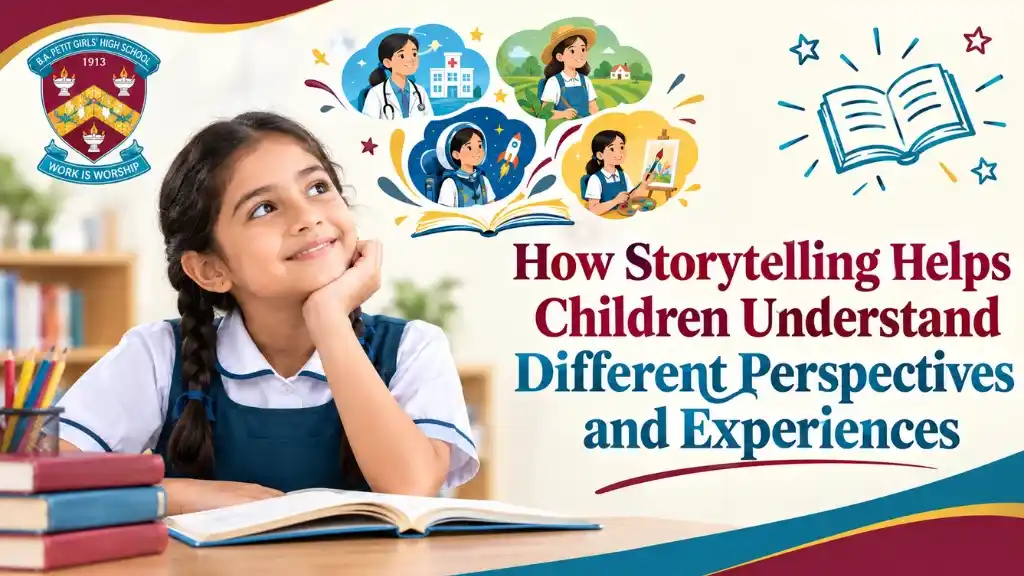
Stories do more than build empathy. They also shape how a girl sees herself and her future. When she reads about Savitribai Phule opening schools for girls, Kalpana Chawla reaching space, or Mary Kom winning in the boxing ring, she begins to picture her own possibilities without limits.
Equally important is the chance to tell her own stories. Sharing an experience aloud, whether a holiday memory or an invented adventure, builds confidence, clear communication, and self-expression. In a supportive Girls School in Mumbai, young learners often find it easier to speak up, share opinions, and take creative risks in front of their peers.
How We Bring Stories to Life at Our School?
At Bai Avabai Framji Petit Girls’ High School, storytelling is woven into everyday learning rather than kept for a single period. Our teachers use it in several ways:
- Story circles, where students sit together, listen, and take turns adding to a shared tale.
- Role-play and classroom drama, which let girls act out characters and feel their choices from the inside.
- Library time, encouraging each child to pick books that reflect both familiar and unfamiliar worlds.
- Guided discussions, where teachers ask open questions and gently welcome every point of view.
These practices help our students grow into thoughtful young women who listen carefully and respond with kindness.
Simple Ways Parents Can Nurture Storytelling at Home
The classroom is only half the journey. Families play an equally vital role, and the good news is that it takes very little time or money.
- Read together every day. Even fifteen minutes before bedtime creates a warm routine and a lifelong love for books.
- Ask questions that go deeper. Instead of “Did you like it?”, try “Why do you think she did that?” or “How would you have felt?”
- Share family stories. Tales of grandparents, old neighbourhoods, or how you celebrated festivals as a child connect your daughter to her roots.
- Choose a wide variety of books. Look for characters from different backgrounds, abilities, and parts of the world.
- Let her be the storyteller. Invite her to invent endings, draw comic strips, or narrate her day, and listen without rushing to correct.
Conclusion
Storytelling is one of the simplest yet most meaningful tools for raising kind, open-minded children. Each tale lets a young girl step outside her own world, understand someone else’s struggles, and return a little wiser and more compassionate. Those lessons stay with her long after the book is closed.
If you are looking for a Girls Primary School in Mumbai that parents can rely on to nurture both the mind and the heart, Bai Avabai Framji Petit Girls’ High School offers a caring environment where stories, curiosity, and empathy grow together.
FAQs
1. How does storytelling help children develop empathy?
Storytelling lets children experience a character’s feelings, struggles, and choices. By imagining how someone else thinks and feels, children learn to recognise emotions, show kindness, and respond thoughtfully to people whose lives differ from their own.
2. Why is storytelling important for primary school children?
Storytelling builds listening skills, imagination, and vocabulary while helping children understand feelings and viewpoints beyond their own. It turns abstract values like kindness, honesty, and respect into memorable lessons young learners can easily relate to.
3. What kind of stories help children understand different cultures?
Folk tales, picture books set in other countries, biographies, and family stories work well. Choose books featuring diverse characters, languages, and traditions so children see that many ways of living are valid and worth respecting.
4. Does storytelling improve a child’s academic performance?
It often does. Regular storytelling strengthens vocabulary, reading comprehension, and attention span. Children who enjoy stories often write more expressively and grasp lessons faster, because they are used to following ideas, sequences, and cause-and-effect.
5. How much time should parents spend reading with their child?
Around fifteen to twenty minutes a day is enough to make a real difference. Consistency matters more than length, so a short bedtime story followed by a friendly chat about the characters works beautifully.