Ask a group of schoolgirls to find the area of a rectangle, and most will reach for a formula. Ask them to plan a vegetable patch for the school terrace on a fixed budget, and something changes. They measure, debate, sketch, rethink, and finally create something they can see and touch. That shift, from memorising to making, sits at the heart of project-based learning.
For parents searching for a Parsi school in Mumbai that prepares daughters for life beyond exams, this approach deserves a closer look. At Bai Avabai Framji Petit Girls’ High School, we believe children learn best when lessons connect to the world outside the classroom window. In this blog, we explain what project-based learning means, how it works day to day, and why it matters so much for girls growing up today.
What Is Project-Based Learning?
Project-based learning (often shortened to PBL) is a teaching method where students explore a real question or challenge over several days or weeks. Instead of hearing about a topic and then writing a test, they investigate it, work together, and produce something meaningful at the end. That outcome might be a model, a short film, a survey report, a campaign poster, or a working prototype.
The key word here is real. A good project starts with a problem that matters to students, such as how to reduce plastic waste in the school canteen or how to make a local park safer for younger children.
How It Differs from Traditional Learning
Textbooks and teacher-led lessons still play an important role. Project work simply builds on them. Here is a quick comparison:
Traditional Classroom | Project-Based Classroom |
Teacher explains, students listen | Students ask questions and investigate |
Learning ends with an exam | Learning ends with a finished product or presentation |
Subjects taught separately | Science, maths, language and art often blend |
Mostly individual work | Plenty of teamwork and discussion |
Correct answers matter most | The thinking process matters just as much |
In short, traditional teaching hands children the knowledge. Project work shows them what to do with it.
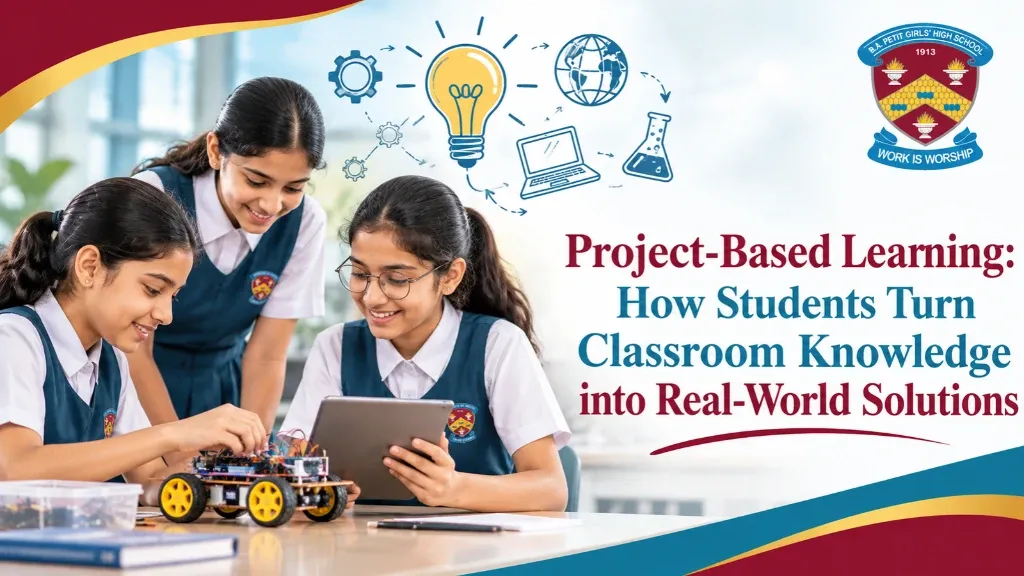
How Students Turn Classroom Knowledge into Real-World Solutions
Every strong project follows a natural rhythm. Children move from curiosity to action, and each stage asks them to use what they have already studied.
1. Begin with a Meaningful Question
A project opens with a “driving question” that has no single right answer. For example: How can our class cut down on water wasted during lunch break? Suddenly, a chapter on the water cycle feels personal.
2. Research and Plan
Students gather facts from books, websites, interviews, and their own observations. They divide roles, set deadlines, and agree on a plan. This is where reading, note-taking, and basic data skills get a genuine workout.
3. Create, Test, and Improve
Next comes the hands-on part. Teams build a model, design a poster, or try out a solution. When something fails, they adjust and try again. Learning to treat mistakes as feedback is one of the most valuable lessons any child can take away.
4. Present to a Real Audience
Finally, students share their work with classmates, parents, teachers, or members of the community. Speaking to a genuine audience pushes them to explain ideas clearly and stand behind their findings.
Project Ideas That Connect Subjects to Everyday Life
Here are a few examples of how familiar subjects can become practical, problem-solving projects:
1. Science: A Green Campus Audit
Girls track electricity, water, and paper use around school, then suggest simple changes and measure the results over a month.
2. Mathematics: Budgeting a Class Event
Students plan a farewell party or charity sale within a set amount, comparing prices, calculating percentages, and keeping accounts.
3. Social Studies: Mapping Our Neighbourhood
Teams study the history, heritage buildings, and civic needs of their locality, then present ideas to make it cleaner or safer.
4. Languages and Art: A Community Awareness Campaign
Girls write slogans, design posters, and script short skits on topics like road safety, healthy eating, or kindness online.
Why Project-Based Learning Matters for Girls
Research from groups such as the OECD and various education bodies has long pointed out that girls often doubt their abilities in subjects like science and maths, even when their marks are strong. Hands-on projects help close that confidence gap because success is visible. A girl who builds a working water filter knows she understands filtration; she does not need a grade to tell her.
- Confidence and a Stronger Voice: Presenting findings, answering questions, and defending a decision in front of others helps girls speak up with assurance. Over time, shy students often surprise themselves.
- Leadership and Teamwork: In every group, someone has to coordinate, someone has to listen, and someone has to resolve disagreements. Rotating these roles lets each girl practise leading as well as supporting.
- Critical Thinking and Problem-Solving: Real problems are messy. Students learn to weigh options, question sources, and choose the most practical path rather than the most obvious one.
- Empathy and Social Responsibility: When projects focus on community needs, children begin to see themselves as people who can make a difference. That sense of purpose stays with them long after school.
This is exactly why many families looking for a Parsi school in Mumbai now ask about hands-on learning during admissions, not just board results and facilities.
Learning by Doing at Bai Avabai Framji Petit Girls’ High School
At Bai Avabai Framji Petit Girls’ High School, we see the classroom as a starting point, not a boundary. Our teachers encourage students to link lessons with activities, group assignments, exhibitions, and community initiatives wherever the curriculum allows. The aim is simple: every girl should leave school knowing not only what she has learnt but also how to use it.
Our focus on girls’ education shapes this approach. In an all-girls setting, students take on every role in a project, from team leader to researcher to presenter, without hesitation. They lead, build, question, and present with growing self-belief.
How Parents Can Support Project Work at Home
Families play a quiet but powerful part. A few easy ways to help:
- Ask open questions such as “What problem are you trying to solve?” rather than “Is it finished?”
- Let your daughter make small mistakes and fix them herself.
- Share everyday challenges, like planning the monthly grocery list, as mini projects.
- Attend exhibitions and presentations whenever possible; an audience means a lot.
- Praise effort, curiosity, and teamwork, not just the final result.
Final Thoughts
Project-based learning turns knowledge into action. It teaches girls that the formulas, facts, and stories they study are tools for improving the world around them. More importantly, it builds the confidence, resilience, and teamwork they will rely on in higher studies, careers, and life.
If you are exploring a Parsi school in Mumbai that values both academic strength and real-world readiness, we warmly invite you to learn more about Bai Avabai Framji Petit Girls’ High School and see how our students learn by doing.
Want to see how your daughter can learn by doing? Visit Bai Avabai Framji Petit Girls’ High School, meet our teachers, and explore our classrooms. Contact our admissions office today.
FAQs
1. What is the meaning of project-based learning?
Project-based learning is a teaching method where students explore a real-life question over several days or weeks. They research, collaborate, and create a final product, such as a model or presentation, that shows what they have understood.
2. How does project-based learning help girls?
It builds confidence, leadership, and problem-solving skills. Girls see their ideas work in practice, present before real audiences, and take on every team role, which helps them trust their abilities in science, maths, and beyond.
3. Does project-based learning replace textbooks and exams?
No. Textbooks and exams still matter. Project-based learning works alongside them, helping students apply what they read in class to practical situations, which often deepens understanding and improves how well they remember concepts.
4. What are some examples of real-world school projects?
Popular examples include auditing water and electricity use on campus, budgeting a class event, mapping local heritage sites, building simple science models, and running awareness campaigns on topics like road safety or healthy eating.
5. How do I choose a school in Mumbai that offers hands-on learning?
Visit the campus, ask how teachers use projects and activities, and look at student work on display. A good Parsi school in Mumbai, like Bai Avabai Framji Petit Girls’ High School, balances academics with practical learning.