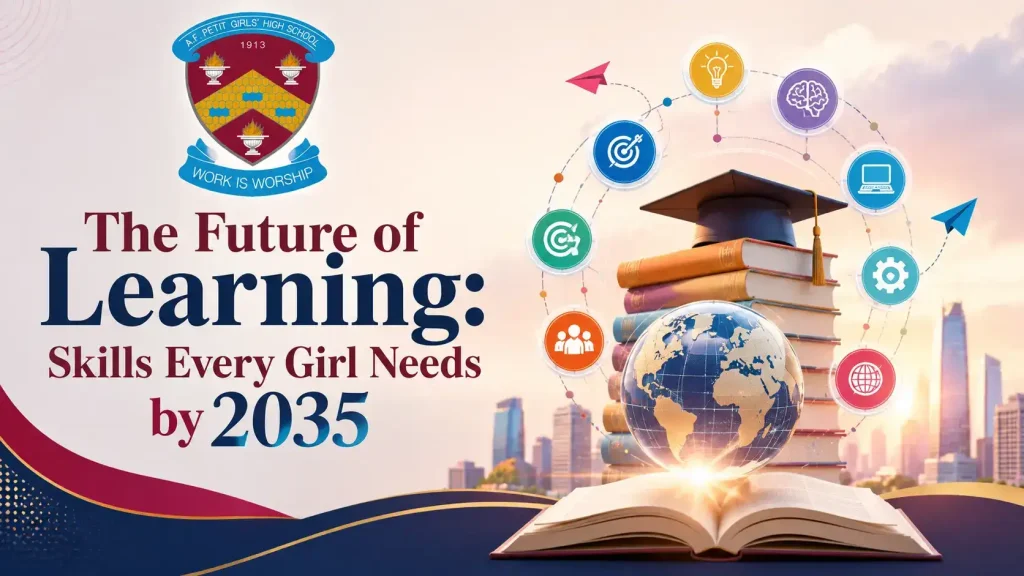
The world our daughters will inherit in 2035 will be dramatically different from the one we know today. Artificial Intelligence will automate routine tasks, technology will reshape industries overnight, and careers that don’t yet exist will become commonplace. In this rapidly evolving landscape, one question matters more than ever:
What skills will help today’s girls thrive tomorrow?
Academic excellence will always remain important, but employers, universities, and global organizations increasingly value skills that go beyond textbooks. According to reports from the World Economic Forum, UNESCO, OECD, and India’s National Education Policy (NEP) 2020, future success will depend on creativity, adaptability, leadership, emotional intelligence, digital literacy, and lifelong learning.
At Avabai Petit School, we believe that preparing girls for the future means nurturing confident thinkers, compassionate leaders, and innovative problem-solvers, not just high scorers in examinations.
Let’s explore the skills every girl should develop before 2035 and how schools and parents can work together to build them.
Why Learning Needs to Change
Education is no longer about memorizing information.
With AI tools capable of answering questions within seconds, knowledge has become instantly accessible. The real advantage lies in knowing:
- How to ask better questions
- How to think critically
- How to evaluate information
- How to solve complex problems
- How to collaborate with people
- How to innovate responsibly
Tomorrow’s workforce won’t reward students simply for what they know, it will reward them for how effectively they apply what they know.
This shift is already influencing university admissions, hiring practices, and global education systems.
1. Critical Thinking & Problem Solving
Future workplaces will expect employees to analyze situations rather than simply follow instructions.
Girls who develop critical thinking skills learn to:
- Evaluate different perspectives
- Make informed decisions
- Solve unfamiliar problems
- Identify misinformation
- Build logical reasoning
At Avabai Petit School, students strengthen these abilities through:
- Inquiry-based learning
- STEM activities
- Classroom discussions
- Research projects
- Science experiments
- Real-world problem-solving activities
Rather than memorizing answers, students are encouraged to explore why something works.
2. AI Literacy & Digital Intelligence
By 2035, AI will become as common as the internet is today.
However, using AI effectively requires more than simply typing prompts into a chatbot.
Students need to understand:
- Responsible AI use
- Ethical technology practices
- Digital safety
- Data privacy
- Prompt engineering basics
- Identifying AI-generated misinformation
- Human oversight in AI-assisted work
AI will not replace learning.
Instead, students who understand AI while developing strong analytical skills will have a significant advantage.
3. Communication Skills
Ideas only create impact when they can be communicated effectively.
Whether presenting a business proposal, leading a project, or speaking in public, communication remains one of the most valuable professional skills.
Students develop confidence through:
- Debates
- Presentations
- Public speaking
- Theatre and performing arts
- Group discussions
- Creative writing
These experiences help girls express ideas clearly while becoming active listeners and confident collaborators.
4. Leadership & Decision-Making
Leadership is not an inborn talent.
It is developed through consistent opportunities to take responsibility, solve problems, and inspire others.
Schools play a vital role by providing opportunities such as:
- Student leadership positions
- House responsibilities
- Event management
- Community initiatives
- Team projects
- Sports leadership
These experiences teach accountability, resilience, empathy, and confidence, qualities that remain valuable throughout life.
5. Creativity & Innovation
Routine tasks are becoming increasingly automated.
Creativity, however, remains uniquely human.
Future-ready students learn to:
- Generate original ideas
- Design innovative solutions
- Think beyond conventional approaches
- Adapt creatively to challenges
Creativity grows through:
- Arts
- Music
- Design activities
- STEM innovation
- Project-based learning
- Entrepreneurship initiatives
Innovation often begins with curiosity.
6. Emotional Intelligence
Success in tomorrow’s world will depend not only on IQ but also on EQ.
Emotional intelligence enables students to:
- Manage emotions
- Build healthy relationships
- Resolve conflicts
- Show empathy
- Work effectively in diverse teams
Activities like collaborative learning, sports, performing arts, mentoring, and community service naturally strengthen these essential life skills.
7. Collaboration & Teamwork
The future belongs to people who can work across cultures, disciplines, and technologies.
Collaborative learning teaches girls how to:
- Respect diverse viewpoints
- Share responsibilities
- Resolve disagreements
- Build trust
- Achieve common goals
Whether in classrooms or future workplaces, teamwork drives innovation.
8. Financial Literacy & Entrepreneurship
Understanding money is becoming a life skill rather than an optional subject.
Students should learn:
- Budgeting
- Saving
- Investing basics
- Responsible spending
- Business fundamentals
- Entrepreneurial thinking
Even girls who never start businesses benefit from entrepreneurial mindsets that encourage initiative, creativity, and calculated risk-taking.
9. Adaptability & Lifelong Learning
Many careers in 2035 haven’t even been created yet.
Future professionals will constantly:
- Learn new technologies
- Upskill
- Change roles
- Work with emerging industries
The ability to learn continuously may become one of the most valuable skills of all.
Schools should cultivate curiosity rather than simply preparing students for examinations.
10. Global Citizenship & Environmental Responsibility
Students will solve challenges that cross national borders.
Climate change, sustainability, global collaboration, and cultural understanding will shape future careers.
Girls should develop:
- Environmental awareness
- Social responsibility
- Cultural sensitivity
- Ethical leadership
- Civic engagement
Community service initiatives, environmental projects, and collaborative activities help students become responsible global citizens.
Future Learning Is Already Changing
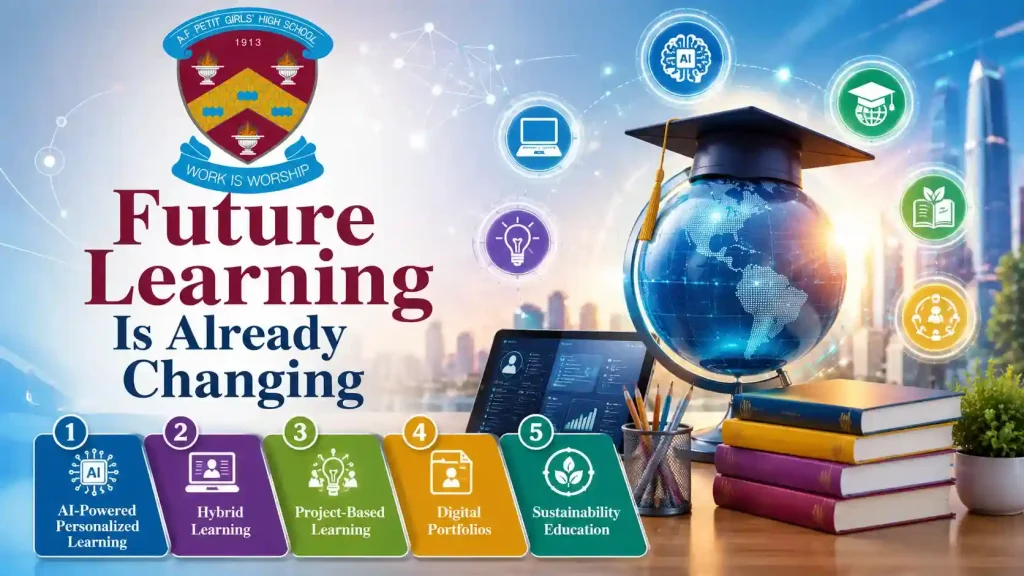
Several educational trends are transforming classrooms today and will become mainstream by 2035.
AI-Powered Personalized Learning
Technology will increasingly help tailor lessons to each student’s pace while teachers focus on mentoring, creativity, and deeper understanding.
Hybrid Learning
Learning will happen both inside and outside classrooms using digital platforms, collaborative tools, and experiential activities.
Project-Based Learning
Students will solve authentic problems instead of completing isolated assignments.
Digital Portfolios
Universities and employers are increasingly interested in portfolios demonstrating projects, leadership, innovation, and real-world achievements alongside academic results.
Sustainability Education
Environmental responsibility will become an integral part of education across subjects.
Why Good Marks Alone Are No Longer Enough
One of the biggest misconceptions is that excellent grades guarantee future success.
Strong academic performance certainly opens doors.
However, employers increasingly seek candidates who can:
- Think independently
- Communicate effectively
- Adapt quickly
- Lead teams
- Solve complex problems
- Learn continuously
Academic excellence combined with future-ready skills creates the strongest foundation for long-term success.
How Avabai Petit School Prepares Girls for the Future
At Avabai Petit School, preparing students for tomorrow goes beyond classroom instruction.
Our educational approach combines academic excellence with holistic development through:
- Inquiry-based learning that nurtures curiosity
- Project-based learning connecting classroom concepts with real-life applications
- STEM education encouraging scientific thinking
- Debates and discussions that build confidence
- Sports promoting teamwork and resilience
- Performing arts fostering creativity and communication
- Community service cultivating empathy and responsibility
- Leadership opportunities that develop confident decision-makers
This balanced approach ensures that students graduate not only with strong academic foundations but also with the confidence, adaptability, and character required to thrive in an ever-changing world.
How Parents Can Prepare Their Daughters for 2035
Parents remain a child’s first teachers.
Here are a few simple ways to support future-ready learning at home:
- Encourage curiosity by welcoming questions.
- Allow children to solve age-appropriate problems independently.
- Promote reading beyond school textbooks.
- Discuss current events and emerging technologies.
- Encourage participation in sports, arts, and extracurricular activities.
- Teach basic financial habits like saving and budgeting.
- Use AI tools responsibly while emphasizing critical thinking.
- Celebrate effort, creativity, and resilience, not just marks.
Final Thoughts
The future will belong to individuals who can adapt, innovate, collaborate, and lead with confidence. While academic excellence remains important, it is no longer enough on its own. The girls who will thrive in 2035 are those who combine knowledge with curiosity, resilience, emotional intelligence, and the ability to embrace change.
At Avabai Petit School, we are committed to nurturing these qualities through a balanced education that prepares every student not just for examinations, but for life. By empowering girls with future-ready skills today, we help them become confident learners, compassionate leaders, and responsible global citizens tomorrow.
Ready to prepare your daughter for the future? Enquire about admissions at Avabai Petit School and discover how our holistic approach to education equips girls with the skills, confidence, and character to succeed in a rapidly evolving world.
Frequently Asked Questions
Critical thinking, communication, leadership, emotional intelligence, AI literacy, creativity, collaboration, adaptability, financial literacy, and global citizenship are among the most important skills for future success.
No. AI will enhance learning by personalizing education and improving access to knowledge, but teachers, critical thinking, creativity, and human interaction will remain essential.
Automation is replacing routine tasks, making communication, leadership, teamwork, emotional intelligence, and problem-solving increasingly valuable across every profession.
Project-based learning helps students apply knowledge to real-world situations, improving collaboration, creativity, research skills, leadership, and practical problem-solving.
Financial literacy empowers girls to make informed financial decisions, build independence, understand investments, and develop confidence in managing personal and professional finances.